Category Archive: Content Marketing

The Only Content Map You’ll Ever Need | Content Strategy

Content Mapping, Content Strategy

One of the things I frequently do for clients is to create content for their website, for social media, for PR, or for other marketing pieces.

When I start a new project, I often hear statements like “we already have most of the content”, or “just write a few quick blog and social media posts and that’ll be our content”, or “our intern is handling the blog and social media”, or “our CEO wrote the copy for the homepage”. Aaargh.

The ROI on that type of “content marketing” is pretty darn low.

Real content creation and marketing needs an upfront strategy, in order to:

  • Ensure the content achieves business goals, like conversions or activation,
  • Keep it flowing and current,
  • Make certain it’s SEO-optimized, and
  • Meet customer needs.

I use a CONTENT MAP to develop a successful upfront content strategy. I map the content types to user emotion and intent. This way, the content follows a typical sales funnel to ensure it is set up to deliver the goals of the business.

Once the content map and strategy is complete, content creation and delivery flows efficiently and effectively.

content strategy, content map, content marketing templateI’m sharing my Content Strategy Map template for you to use for your next content marketing project or website design. I developed it based on lots years of learnings in digital marketing! You’ll find it captures most, if not all, of the kinds of content you’ll need. As you can see, its filled in with placeholder copy so you get the idea behind the different parts of the map.

Feel free to download the Content Strategy Map now (it’s in PDF form). I’m confident it will be the only content map you’ll ever need!

[Of course, if you want help with content creation for your website, blog, or social media, just fill out the form on the left to contact me, and I’ll be happy to get your content flowing!]

NOTE: I can’t claim to have invented the business of content strategy, and these smart marketers were great resources for this post: Kristina Halvorson’s Content Strategy for the Web, Kane Jamison of Content Harmony, and the folks over at Wordstream.

Continue Reading

Why Images Are So Important for Social Media Engagement

Why Images Are So Important for Social Media Engagement

You know the old saying, “a picture is worth a thousand words”? The other day, I wondered two things about it:

  1. Where did the saying came from? and,
  2. Is there real research behind it?

A little Google-ing got me the answer to the first. It turns out that its ‘introduction’ is attributed to Frederick R. Barnard, who published an article touting the effectiveness of graphics over just copy with the title “One Look is Worth a Thousand Words“, in the Dec. 8, 1921 edition of the advertising journal, Printer’s Ink.

Fred was clearly on to something.

I found the answer to the second question in scads of consumer market research, backed up by my own experience helping businesses get more results through social networking and blogging.

Here’s what the research says:

  • According to Kissmetrics, images on Facebook receive 53% more Likes, 104% more comments, and 84% more click-throughs on links. 53%! 104%! 84%! That made you sit up, huh?
  • In addition, the most recent Facebook redesign makes images even more important for newsfeed visibility.
  • Research from Buffer shows that using images on Twitter increases retweets by 150% and click-throughs by 18%.
  • PRNewswire found that images included in a press release expand the release’s audience up to 180%.
  • Brain research shows that almost half of our brain is involved in visual processing - and we can make sense of a visual in less than 1/10 of a second! Conversely, on average, we only read 28% of words on any given web page. Ouch.

I’ll say it again. Fred was clearly on to something.

Images used in your social media (and by definition, your blog content) are far more attention-grabbing than text or plain old links, more likely to be shared, evoke emotional reactions in viewers (and emotion SELLS), and can portray a lot of information quickly and more efficiently than text.

Google’s Abigail Posner explains why engaging with an image feels so compelling to us humans:

“When we see or create an image that enlivens us, we send it to others to give them a bit of energy and effervescence. Every gift holds the spirit of the gifter. Also, every image reminds us and others that we’re alive, happy and full of energy (even if we may not always feel that way). And when we ‘like’ or comment on a picture or video sent to us, we’re sending a gift of sorts back to the sender… this ‘gift’ of sharing contributes to an energy exchange that amplifies our own pleasure.”

Convinced? Good. Now, here are a few suggestions on how to execute:

  • Include at least one image in every blog post. Don’t skip this step.
  • I recommend sizing the image(s) to 1/2 the width of your blog post.
  • Make sure your images are high quality and relevant.
  • Edit images using visual design that attracts eyeballs, e.g., the right color, contrast, texture, shape, balance, proportion - here’s a good summary guide from Curalate.
  • Consider adding text to your images and photos - quotes are highly shareable.
  • Even better, use infographics.
  • Use images with personality!
  • If it’s right for your business, collect and post user-generated images.

As to sources for your images, you can 1) create your own - I’ll have more on this in an upcoming blog post - or 2) you can source them online:

  • Creative Commons Images (images that are legal to use in your marketing) – Try Flickr’s Advanced Search. Be sure to check the box to Only search within Creative Commons-licensed content and include a photo credit with images you use.
  • Royalty-Free Stock Photos – Try stock photo sites like Stock.xchng or iStockphoto that have a fair amount of free or low-cost stock imagery to license.

Lastly, to optimize your images for the various social media platforms, try the Social Image Resizing Tool, which has preset image sizing (!) for all the primary social media sites.

And remember Fred. Even back in 1921, he was on to something.

Continue Reading

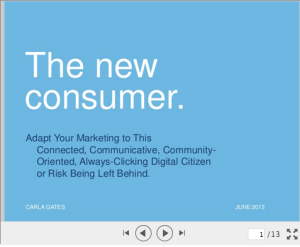
The New Consumer: Adapt Your Marketing to this Connected, Communicative, Community-Oriented, Always-Clicking Digital Citizen, or Risk Being Left Behind

The new consumer — sometimes called “Generation C” — is:

  • Connected
  • Communicative
  • Content-Centric
  • Computerized
  • Community-oriented
  • Always clicking
  • In control

The New Connected Consumer

Today’s consumers have fundamentally changed their relationship with media and technology…and with brands. They don’t want to be talked at, instead they want to be invited to the discussion. And their online behavior has less to do with the year they were born and more to do with their attitide and mindset.

So, what does the new consumer want? And what should you as a marketer do about it? Find out in my latest presentation.

Continue Reading

How the Amish Mafia Sucked Me In (or, Bad Headlines Are a Death Knell for Your Content)

Amish Mafia: Writing Great Headlines

Image credit: Discovery Channel

Amish Mafia. I admit the title sucked me in. I’m not normally a seeker of sensationalism, and I have happy memories of a childhood trip to what my Dad called “Pennsylvania Dutch country”. It seemed like a peaceful, crime-free place.

But that title. Such an oxymoron. So I tuned in to the Discovery Channel television show, out of morbid curiosity.

The title got me to consume the rest of the content.

It’s the same online.

According to Copyblogger’s Brian Clark, Online, “on average, 8 out of 10 people will read title or headline copy, but only 2 out of 10 will read the rest.”

When you write any kind of digital content, whether it’s a blog post, a video, an email subject line, or an infographic, pay special attention to the headline.

Many copywriters subscribe to the 50/50 Rule of Headlines, which means you should spend as much time on the title as you do on the rest of the content.

However, I’m going to disagree with that rule, and tell you instead to follow the lead of Brian Clark’s metrics, and focus 80% of your time the title and 20% of the time on the post.

See how the title of this blog post got you to read more? (And by the way, shamelessly riding the coattails of popular online memes in your titles is a completely legitimate tactic. After all, the whole point of content marketing is to get readers to your website, and then to take whatever action improves your ROI, right?)

Bad headlines do the opposite. They sit out there on Twitter or Facebook or YouTube and gather moss. Or to use yet another idiom, your content dies on the vine.

So, here are 4 ways to think about writing sensational titles that will instantly suck readers right to your content, just like the Discovery Channel did to me:

  • Be sensational. This tactic you’ve already learned from the title of this blog post. Tapping into a controversy can be great for drawing your readers in. (And apparently oxymoronic titles work very well.) But do make sure that you back up your opinion with the content of your post. And be prepared for possible strong reactions if you’re writing about a particularly touchy subject. And do keep it civil. Ultimately you want to be proud of your content.
  • Solve a problem. Identify the problems and pain points faced by your audience, and then communicate to them through the title that your post will address this need.
  • Use catchy phrases. Some words and phrases are just better at getting the attention of readers than others. For example, blog posts formatted as lists “Top 10 Ways to…,” “Top 5 Tips for…,” even though used frequently, continue to get more clicks than other posts, as do blogs titles that use words like “free,” “secrets,” “revealed,” and “easy”. Just don’t overuse those words, as it will ultimately dilute your effectiveness.
  • Ask questions. A question in your blog post title is a great way to draw in readers, and also encourages them to leave comments. Ask an open-ended question that will spark a variety of answers and opinions, rather than a yes-or-no question. You can state your own feelings on the subject in the post, but leave open room for other opinions and discussion.

And don’t forget to use your keywords in the title!

What about you? What tactics do you use in title-writing? What titles would you add to the Hall of Fame, or conversely, the Hall of Shame?

Continue Reading