Tag Archive: content marketing

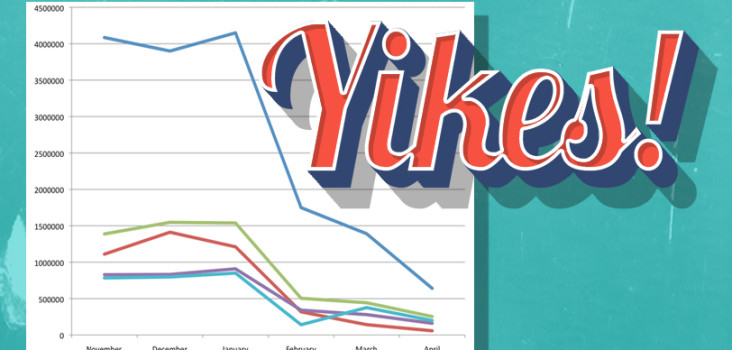
The Client Asks: “Why Is My Website Traffic Decreasing?”
Website traffic

I’ll start by saying that this question is more complex than it looks. Bad news.

But the good news is that you can uncover the issues impacting traffic, and/or jump right into resolution, depending on your timeframe and resources. Here are some of the top reasons for decreasing website traffic (assuming it’s even a metric you need to get worried about - see#1 below), with suggestions for resolution, as well as additional resources.

  1. First, know that the success of a website is not necessarily measured by web site visits alone. Additional metrics from Google Analytics should be considered. Ultimately, you want qualified leads coming to your site; rather than an increasing number of unqualified leads. Unless you can tell which you’ve got, it’s hard to make a judgement about traffic alone. If you know your site is set up well to drive traffic, then look to optimizing your marketing efforts as a start.
  2. In reality, businesses have to market a lot to drive traffic to their site. (I’m going to assume you’ve already optimized your site for SEO).
    1. Email is the most successful traffic driver. Make sure you’re doing all you can to collect the email addresses of your interested-but-not-yet-ready-to-buy prospects. If you are, then email them regularly with valuable content which includes links back to your website (and make sure there are good reasons why they should want to click back to your site!)
    2. The next best source of traffic is Thought Leadership, otherwise known as Content, i.e., blog posts, webinars, white papers, conference talks, etc.
      1. Frequent (but valuable!) blog posts drive traffic. A recent Hubspot study showed that “companies that publish 16+ blog posts per month got almost 3.5X more traffic than companies that published between 0 - 4 monthly posts.” . In other words, you gotta’ blog a lot!
      2. In addition, consider other content mechanisms. For example, host a monthly webinar series providing prospects with valuable and relevant industry information. Find well-known guest authors to write white papers for which you can require email addresses to download. Record any panel or conference talks you give, and then post that content on Slideshare, as well as your own site, after the event.
      3. Finally, make sure you are distributing all this content across relevant social media channels frequently (this post shares frequency best practices)
  3. It may be that one or more of your competitors has done something new (such as increasing marketing efforts) and is suddenly drawing away prospects that may have gone to your site. It goes without saying that you should keep an eye on competitor marketing efforts.
  4. In the beginning of 2015, Google made a change to its search algorithm so that it now requires sites to be mobile-optimized in order to rank well. If your site isn’t truly mobile-friendly, it will definitely impact traffic.
  5. Finally, there are a host of website technical issues that can impact website traffic (e.g., site load time, accidental duplicate content, expired SSL certificate, etc.). You’ll need your developer(s) to investigate these.

There are certainly other issues that can impact site traffic, but if you go through the list above, you should be able to turn that trend around.

Continue Reading

Actionable Content Marketing Stats You Should Know

content marketing metrics

Content Marketing Works & Research Shows Buyers Respond to It

Consumers’ average attention span is 8 seconds – 1 second less than a goldfish. [Source]

70% of consumers prefer getting to know a company via articles rather than ads. [Source]

57% — that’s how far the average B2B buyer is through the purchase decision before engaging a supplier sales rep. [Source]

Inbound (content) marketing delivers 54% more leads into the marketing funnel than traditional outbound leads. [Source]

Content marketing generates 3 times as many leads as traditional outbound marketing, but costs 62% less. [Source]

60% of people are inspired to seek out a product after reading content about it. [Source]

The top content formats that B2B buyers seek to research a purchase include: whitepapers (78%), case studies (73%), webinars (67%), eBooks (58%), videos (58%), blog posts (56%), and infographics (52%). All other formats fall below 50%. [Source]

B2B buyers share these content formats more frequently with colleagues: blog posts (40%), infographics (39%), videos (37%), white papers (34%), case studies (29%). [Source]

Blogging Creates a Relationship with Prospects & Customers

82% of marketers who blog see positive ROI for their inbound marketing [Source]

80% of internet users are reached by social media sites and blogs [Source]

82% of buyers feel more positive about a company after reading custom content [Source]

78% perceive a relationship with a company after reading custom content [Source]

Companies that increase blogging from 3-5X/month to 6-8X/month almost double their leads. [Source]

SEO & Keywords Meet Prospects Where They Are

B2B buyers conduct an average of 12 searches before ever jumping on a specific brand’s site. [Source]

61% of global Internet users research products online. [Source]

SEO leads have a 14.6% close rate, while outbound leads (such as direct mail or print advertising) have a 1.7% close rate. (Source)

Email & Lead Nurturing - The Most Effective Way to Convert

Emails sent via marketing automation drive 18x more revenue than email blasts. [Source]

79% of marketing leads never convert into sales. Lack of lead nurturing is the common cause of this poor performance. [Source]

Nurtured leads make 47% larger purchases than non-nurtured leads. [Source]

Nurtured leads produce, on average, a 20% increase in sales opportunities versus non-nurtured leads. [Source]

Facebook - 72% of Online Adults Use It. You Can’t Ignore It.

Posts that contains photos make-up 93% of the most engaging posts. [Source]

Most engagement occurs towards the end of the week from Wednesday to Friday. [Source

Question posts get 100% more comments than standard text-based posts. [Source]

35% of users participate in contests, 42% like a page in order to get a discount or coupon. [Source]

Timeless Twitter Tips

Image links can get 2x the engagement rate. [Source]

Tweets with hashtags get 2x more engagement [Source]

Tweets have a 12x higher chance of being retweeted if you ask for it, and 23x higher if you actually spell out the word “retweet” [Source]

~~~

>> Overwhelmed by the thought of creating your own content marketing strategy? Or simply need a one-off, conversion-friendly white paper, infographic, or case study? Email carla@3to5marketing and let’s generate some leads!


Continue Reading

The Only Content Map You’ll Ever Need | Content Strategy

Content Mapping, Content Strategy

One of the things I frequently do for clients is to create content for their website, for social media, for PR, or for other marketing pieces.

When I start a new project, I often hear statements like “we already have most of the content”, or “just write a few quick blog and social media posts and that’ll be our content”, or “our intern is handling the blog and social media”, or “our CEO wrote the copy for the homepage”. Aaargh.

The ROI on that type of “content marketing” is pretty darn low.

Real content creation and marketing needs an upfront strategy, in order to:

  • Ensure the content achieves business goals, like conversions or activation,
  • Keep it flowing and current,
  • Make certain it’s SEO-optimized, and
  • Meet customer needs.

I use a CONTENT MAP to develop a successful upfront content strategy. I map the content types to user emotion and intent. This way, the content follows a typical sales funnel to ensure it is set up to deliver the goals of the business.

Once the content map and strategy is complete, content creation and delivery flows efficiently and effectively.

content strategy, content map, content marketing templateI’m sharing my Content Strategy Map template for you to use for your next content marketing project or website design. I developed it based on lots years of learnings in digital marketing! You’ll find it captures most, if not all, of the kinds of content you’ll need. As you can see, its filled in with placeholder copy so you get the idea behind the different parts of the map.

Feel free to download the Content Strategy Map now (it’s in PDF form). I’m confident it will be the only content map you’ll ever need!

[Of course, if you want help with content creation for your website, blog, or social media, just fill out the form on the left to contact me, and I’ll be happy to get your content flowing!]

NOTE: I can’t claim to have invented the business of content strategy, and these smart marketers were great resources for this post: Kristina Halvorson’s Content Strategy for the Web, Kane Jamison of Content Harmony, and the folks over at Wordstream.

Continue Reading

Why Images Are So Important for Social Media Engagement

Why Images Are So Important for Social Media Engagement

You know the old saying, “a picture is worth a thousand words”? The other day, I wondered two things about it:

  1. Where did the saying came from? and,
  2. Is there real research behind it?

A little Google-ing got me the answer to the first. It turns out that its ‘introduction’ is attributed to Frederick R. Barnard, who published an article touting the effectiveness of graphics over just copy with the title “One Look is Worth a Thousand Words“, in the Dec. 8, 1921 edition of the advertising journal, Printer’s Ink.

Fred was clearly on to something.

I found the answer to the second question in scads of consumer market research, backed up by my own experience helping businesses get more results through social networking and blogging.

Here’s what the research says:

  • According to Kissmetrics, images on Facebook receive 53% more Likes, 104% more comments, and 84% more click-throughs on links. 53%! 104%! 84%! That made you sit up, huh?
  • In addition, the most recent Facebook redesign makes images even more important for newsfeed visibility.
  • Research from Buffer shows that using images on Twitter increases retweets by 150% and click-throughs by 18%.
  • PRNewswire found that images included in a press release expand the release’s audience up to 180%.
  • Brain research shows that almost half of our brain is involved in visual processing - and we can make sense of a visual in less than 1/10 of a second! Conversely, on average, we only read 28% of words on any given web page. Ouch.

I’ll say it again. Fred was clearly on to something.

Images used in your social media (and by definition, your blog content) are far more attention-grabbing than text or plain old links, more likely to be shared, evoke emotional reactions in viewers (and emotion SELLS), and can portray a lot of information quickly and more efficiently than text.

Google’s Abigail Posner explains why engaging with an image feels so compelling to us humans:

“When we see or create an image that enlivens us, we send it to others to give them a bit of energy and effervescence. Every gift holds the spirit of the gifter. Also, every image reminds us and others that we’re alive, happy and full of energy (even if we may not always feel that way). And when we ‘like’ or comment on a picture or video sent to us, we’re sending a gift of sorts back to the sender… this ‘gift’ of sharing contributes to an energy exchange that amplifies our own pleasure.”

Convinced? Good. Now, here are a few suggestions on how to execute:

  • Include at least one image in every blog post. Don’t skip this step.
  • I recommend sizing the image(s) to 1/2 the width of your blog post.
  • Make sure your images are high quality and relevant.
  • Edit images using visual design that attracts eyeballs, e.g., the right color, contrast, texture, shape, balance, proportion - here’s a good summary guide from Curalate.
  • Consider adding text to your images and photos - quotes are highly shareable.
  • Even better, use infographics.
  • Use images with personality!
  • If it’s right for your business, collect and post user-generated images.

As to sources for your images, you can 1) create your own - I’ll have more on this in an upcoming blog post - or 2) you can source them online:

  • Creative Commons Images (images that are legal to use in your marketing) – Try Flickr’s Advanced Search. Be sure to check the box to Only search within Creative Commons-licensed content and include a photo credit with images you use.
  • Royalty-Free Stock Photos – Try stock photo sites like Stock.xchng or iStockphoto that have a fair amount of free or low-cost stock imagery to license.

Lastly, to optimize your images for the various social media platforms, try the Social Image Resizing Tool, which has preset image sizing (!) for all the primary social media sites.

And remember Fred. Even back in 1921, he was on to something.

Continue Reading

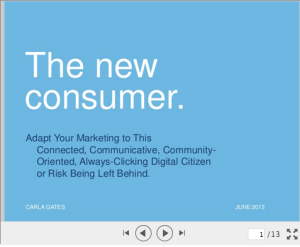
The New Consumer: Adapt Your Marketing to this Connected, Communicative, Community-Oriented, Always-Clicking Digital Citizen, or Risk Being Left Behind

The new consumer — sometimes called “Generation C” — is:

  • Connected
  • Communicative
  • Content-Centric
  • Computerized
  • Community-oriented
  • Always clicking
  • In control

The New Connected Consumer

Today’s consumers have fundamentally changed their relationship with media and technology…and with brands. They don’t want to be talked at, instead they want to be invited to the discussion. And their online behavior has less to do with the year they were born and more to do with their attitide and mindset.

So, what does the new consumer want? And what should you as a marketer do about it? Find out in my latest presentation.

Continue Reading