Category Archive: Work Hacks

Advertising Your Brand: How Many Times Do Consumers Need to See/Hear It Before They Buy?

burmashave

Mad Men-era advertising wiz, Herbert Krugman (Ted Bates, Inc., GE, and Raymond Loewy), took a special interest in consumer behavior. In order to plan efficient TV media buys, he did research in the late 1960s, on how many times consumers needed to see an ad for the same product or brand, before taking an action (i.e., buying). This is how he came up with his famous Theory of Effective Frequency for advertising.

Intuitively we know that repetition (frequency) is the basis of any learning process, and it’s no different for consumers learning about a product. However, since cost optimization is an important consideration in media planning, the issue for advertisers is to limit the frequency to the point where diminishing returns occur.

After some research, Krugman initially concluded that the magic number was three. In other words, after seeing or hearing about a product or brand three times, consumers would take an action. As he explained it,

  • “The first time someone is exposed to your ad, you attract their attention, but nothing is really taken in, thus “What is it?”.
  • The second time is when the consumer begins to engage with the relevance of the ad, and asks “So what?”
  • And the third exposure to the ad is when the viewer decides whether “This is for me”, or whether they will choose to forget it.”

Of course, a number of factors impact this ad frequency theory, for example: how well known the product or brand is already, the audience category, the complexity of the product or message, the cost structure of the product, the saturation level of the market, and more.

brain, advertising, theory of effective frequencyLater research (including some done by Krugman) suggested the number was more than 3 . For example, Canadian Grant Hicks decided it was five touches, based on his research on financial advisors and their clients. Nielsen media guru Erwin Ephron’s work lead him to conclude it was three to five touches. More recently, a Nielsen study claims ten social media touches are needed to effect a behavior change.

Whether the number is 3 or 5 or more, the point here is that you’ve got to get your product in front of your customers multiple times in order for them to take the action you want.

Surprisingly, this isn’t always obvious to all businesses – I worked with a CEO once who wondered why the ONE direct mail campaign he approved didn’t bring in the results he wanted. And his product was fairly complex and new to the market – it would have benefitted from multiple advertising touches. Instead, he concluded that marketing wasn’t working for his product.

The great thing about digital marketing today is that there are many cost-effective ways to achieve your multiple marketing touches: email, social media, display advertising, websites, microsites, sponsorships, content marketing, etc. And you can test each channel in order to find the right combination for your customers and brand, with much less cost and effort than Herb Krugman could back in 1969 when TV, radio, and print were the primary advertising channels.

Sources for more information:

  • Herbert E. Krugman. “The Impact of Television Advertising: Learning Without Involvement” Public Opinion Quarterly, volume 29, page 349, 1965.
  • Herbert E. Krugman. “Why Three Exposures May Be Enough.” Journal of Advertising Research 12, 6 (1972): 11-14
  • Batra, Rajeev, Donald R. Lehmann, Joanne Burke, and Jae Pae. “When Advertising Have An Impact? A Study of Tracking Data.” Journal of Advertising Research 35, 5 (1995): 19-32

Image Attribution:

Continue Reading

Why Images Are So Important for Social Media Engagement

Why Images Are So Important for Social Media Engagement

You know the old saying, “a picture is worth a thousand words”? The other day, I wondered two things about it:

  1. Where did the saying came from? and,
  2. Is there real research behind it?

A little Google-ing got me the answer to the first. It turns out that its ‘introduction’ is attributed to Frederick R. Barnard, who published an article touting the effectiveness of graphics over just copy with the title “One Look is Worth a Thousand Words“, in the Dec. 8, 1921 edition of the advertising journal, Printer’s Ink.

Fred was clearly on to something.

I found the answer to the second question in scads of consumer market research, backed up by my own experience helping businesses get more results through social networking and blogging.

Here’s what the research says:

  • According to Kissmetrics, images on Facebook receive 53% more Likes, 104% more comments, and 84% more click-throughs on links. 53%! 104%! 84%! That made you sit up, huh?
  • In addition, the most recent Facebook redesign makes images even more important for newsfeed visibility.
  • Research from Buffer shows that using images on Twitter increases retweets by 150% and click-throughs by 18%.
  • PRNewswire found that images included in a press release expand the release’s audience up to 180%.
  • Brain research shows that almost half of our brain is involved in visual processing - and we can make sense of a visual in less than 1/10 of a second! Conversely, on average, we only read 28% of words on any given web page. Ouch.

I’ll say it again. Fred was clearly on to something.

Images used in your social media (and by definition, your blog content) are far more attention-grabbing than text or plain old links, more likely to be shared, evoke emotional reactions in viewers (and emotion SELLS), and can portray a lot of information quickly and more efficiently than text.

Google’s Abigail Posner explains why engaging with an image feels so compelling to us humans:

“When we see or create an image that enlivens us, we send it to others to give them a bit of energy and effervescence. Every gift holds the spirit of the gifter. Also, every image reminds us and others that we’re alive, happy and full of energy (even if we may not always feel that way). And when we ‘like’ or comment on a picture or video sent to us, we’re sending a gift of sorts back to the sender… this ‘gift’ of sharing contributes to an energy exchange that amplifies our own pleasure.”

Convinced? Good. Now, here are a few suggestions on how to execute:

  • Include at least one image in every blog post. Don’t skip this step.
  • I recommend sizing the image(s) to 1/2 the width of your blog post.
  • Make sure your images are high quality and relevant.
  • Edit images using visual design that attracts eyeballs, e.g., the right color, contrast, texture, shape, balance, proportion - here’s a good summary guide from Curalate.
  • Consider adding text to your images and photos - quotes are highly shareable.
  • Even better, use infographics.
  • Use images with personality!
  • If it’s right for your business, collect and post user-generated images.

As to sources for your images, you can 1) create your own - I’ll have more on this in an upcoming blog post - or 2) you can source them online:

  • Creative Commons Images (images that are legal to use in your marketing) – Try Flickr’s Advanced Search. Be sure to check the box to Only search within Creative Commons-licensed content and include a photo credit with images you use.
  • Royalty-Free Stock Photos – Try stock photo sites like Stock.xchng or iStockphoto that have a fair amount of free or low-cost stock imagery to license.

Lastly, to optimize your images for the various social media platforms, try the Social Image Resizing Tool, which has preset image sizing (!) for all the primary social media sites.

And remember Fred. Even back in 1921, he was on to something.

Continue Reading

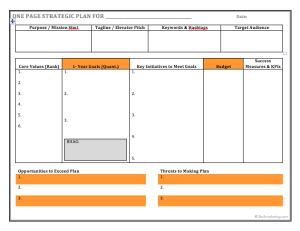
A Treasure Map for Your Business: Create Your One-Page Strategic Marketing Plan

One Page Marketing Strategy

Do I really need yet another strategic document for my business?!

Yes. You do. But this may be the last one you’ll ever need! Because this one rocks!

This one will drive your business on the road from We’reAllOverthePlaceVille to Success City. This is the roadmap that will get you to your dream destination – business success!

Even better, like an old-fashioned treasure map, this one is just one page (and is much less wrinkled).

This is the One Page Strategic Marketing Plan (but you can keep calling it a Treasure Map, because following it will bring you business gold).

Here are the 5 reasons you need it:

  1. Helps you focus your energy on driving your business forward.
  2. Weeds out non-essential marketing opportunities.
  3. Prioritizes your marketing budget.
  4. Gets all staff and partners aligned on common objectives.
  5. Sets the quantitative goals by which to measure your marketing tactics.

One Page Strategic Marketing Plan by 3to5 Marketing

You can download my version here - OnePageStrategicPlan. Put it up on your wall or white board. Gather the troops and have at it! And don’t forget your BHAG (big hairy audacious goal).

For more detail on the individual elements of a strategic marketing plan, Dave Lavinsky writes a great post over at Forbes.com.

Now, go find your treasure!

Continue Reading

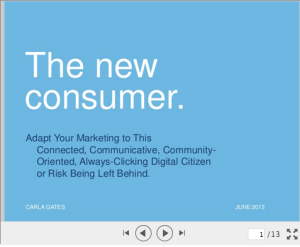
The New Consumer: Adapt Your Marketing to this Connected, Communicative, Community-Oriented, Always-Clicking Digital Citizen, or Risk Being Left Behind

The new consumer — sometimes called “Generation C” — is:

  • Connected
  • Communicative
  • Content-Centric
  • Computerized
  • Community-oriented
  • Always clicking
  • In control

The New Connected Consumer

Today’s consumers have fundamentally changed their relationship with media and technology…and with brands. They don’t want to be talked at, instead they want to be invited to the discussion. And their online behavior has less to do with the year they were born and more to do with their attitide and mindset.

So, what does the new consumer want? And what should you as a marketer do about it? Find out in my latest presentation.

Continue Reading

“I have not yet begun to fight!” | What Did John Paul Jones Have in Common with Today’s Elite Sales Pros?

John Paul Jones house, Portsmouth, NH

John Paul Jones house, Portsmouth, NH

In a former role at a start-up, I worked closely with the Sales team, feeding them leads we generated from our marketing efforts.

Up close, I got to see the anxiety over cold calls, the agony of rejection, but also the exhilaration of landing a big deal after a long sales cycle. I don’t pretend to know how they do their job, but I did learn a lot about what separates elite sales professionals who keep driving away at a goal, from those that barely make quota.

In Portsmouth, NH, on a recent weekend, we came across the “John Paul Jones House” on Middle St., where the famous Revolutionary Naval War hero lived between 1777 and 1782.

John Paul Jones is most famous for NOT giving up, even as his own ship, the U.S.S. Bonhomme Richard, sank around him.

As the legend goes, after conducting sea raids on the coast of Britain, he took command in 1779 of a rebuilt French merchant ship, renamed the U.S.S. Bonhomme Richard. On September 23, 1779, Jones engaged the British frigate Serapis in the North Sea, daringly sailing in close, lashing his vessel to the British ship, and fighting the battle at point-blank range. During the fight, two of his cannon broke, and the British Captain asked Jones if he was ready to surrender. Replied Jones: “Sir, I have not yet begun to fight!” as he rallied his team for yet another assault.

The American crew finally boarded the Serapis after the British had surrendered her colors, and from the deck of the Serapis they watched their own ship sink into the North Sea, having won the battle and captured the Serapis.

So, what did John Paul Jones have in common with elite sales pros of today?

  • He had a good team;
  • He thought highly of his abilities;
  • He took risks;
  • He assumed he would win the battle, even as his ship was sinking around him;
  • He never gave up;
  • He psyched out the competition, who must have thought he was crazy for not perceiving his own imminent defeat; and
  • He inspired his team with his stated confidence in his and their abilities.

Who knows which of the above was the key to Jones’ victory….was it his belief in himself and his team, or did he intimidate the competition with his loudly proclaimed self-confidence? Or both?

Today’s sales pros face similar odds: According to a recent CSO Insights report, only 52.4% of sales reps at the companies surveyed made sales quota last year. As a point of comparison, that number was 61.1% the year before.

So what do you do? Think like John Paul Jones….get together a good team, take risks, think positively, psych out the competition, and above all, as the ship is sinking, yell out, “I have not yet begun to sell!”

Continue Reading